Is Functional Medicine Evidence-Based? What Research Shows
Is Functional Medicine Evidence-Based?
Written by Kerri Rachelle, PhD c., RDN, CSSD, FMP-AC
Founder & CEO, REV0lution | Doctor of Integrative & Natural Medicine Candidate
Reviewed for scientific accuracy: July 2026
Quick Answer
Yes— core principles of functional medicine are strongly supported by scientific evidence. Nutrition, physical activity, sleep, stress management, smoking cessation, healthy body composition, and cardiometabolic disease prevention are among the most well-studied interventions in healthcare. However, like any healthcare model, not every functional medicine test, supplement, or protocol carries the same level of evidence. The best functional medicine practitioners combine current research, clinical expertise, and patient preferences to deliver personalized, evidence-informed care.
Key Takeaways
Functional medicine should be evidence-informed and grounded in current scientific research.
Evidence-based medicine is more than research alone—it also includes clinical expertise and patient values.
Many lifestyle interventions central to functional medicine have decades of scientific support.
Some specialized laboratory testing and supplement protocols have stronger evidence than others and should be selected thoughtfully.
Personalized care allows clinicians to apply the best available evidence to the individual rather than relying on a one-size-fits-all approach.
What Does "Evidence-Based Medicine" Actually Mean?
The phrase "evidence-based medicine" is often used in healthcare, but it's also one of the most misunderstood.
Many people assume evidence-based medicine simply means following published research. While research is essential, that was never the complete definition.
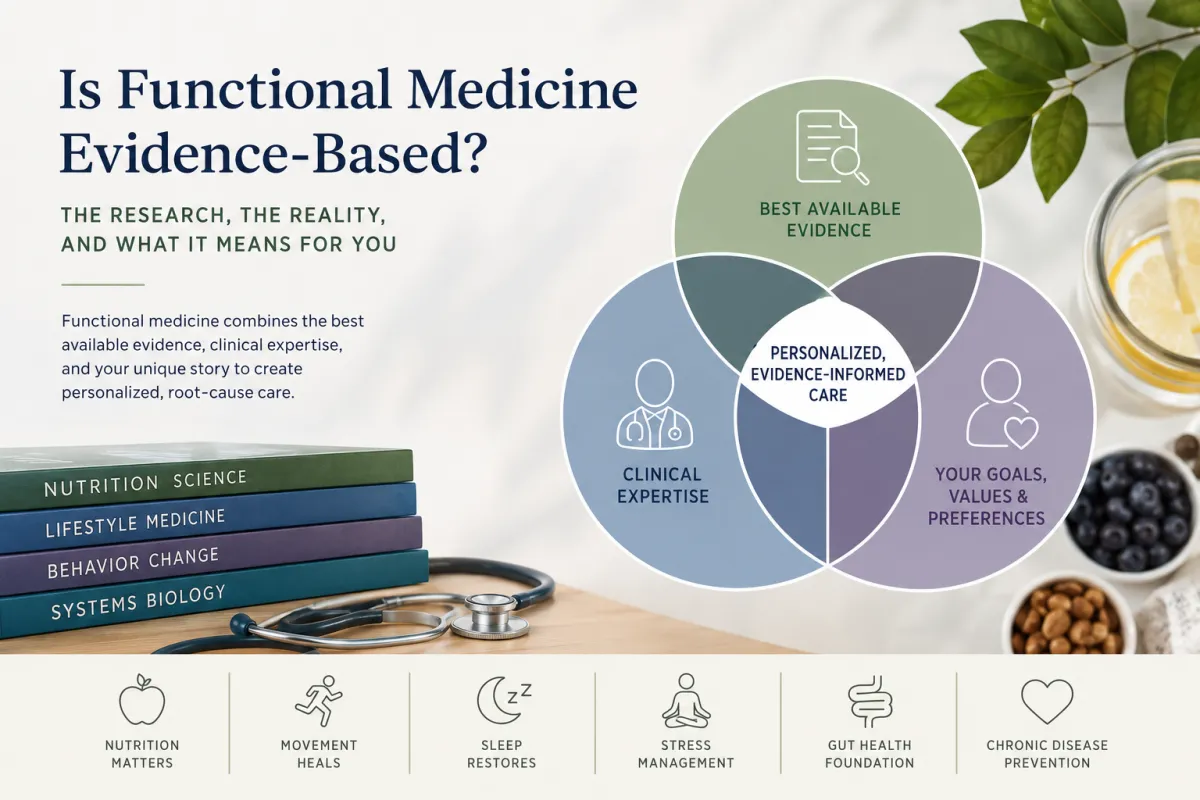
One of the founders of evidence-based medicine, Dr. David Sackett, described it as the integration of three equally important components:
The best available scientific evidence
Clinical expertise
The values, goals, and preferences of the patient
These three components work together.
Imagine two people with the same diagnosis of type 2 diabetes.
Both have similar laboratory results, but one works overnight shifts, has chronic knee pain that limits exercise, and cares for an aging parent. The other is recently retired, enjoys cooking, and has few barriers to lifestyle change.
The scientific evidence supporting nutrition, physical activity, and weight management is the same for both individuals. However, the most appropriate treatment plan is unlikely to be identical.
Evidence-based care recognizes that research provides direction, but clinicians must also consider the individual's medical history, daily life, goals, and preferences to create a realistic and sustainable plan.
This is one reason healthcare has steadily moved toward more personalized models of care over the past two decades. Rather than applying the same recommendations to every person with the same diagnosis, clinicians increasingly recognize that successful treatment depends on understanding the individual behind the condition.
Functional medicine follows this same philosophy. It uses research as the foundation while adapting recommendations to the unique needs of each patient.
Is Functional Medicine Evidence-Based?
This question deserves more than a simple yes or no.
Functional medicine is not a single treatment, medication, or protocol that can be studied in isolation. It is a clinical approach that brings together multiple evidence-based disciplines—including nutrition, exercise science, behavioral medicine, sleep science, stress physiology, systems biology, and chronic disease prevention—to understand the factors influencing an individual's health.
Because of this, the quality of evidence varies depending on the specific intervention being discussed.
For example, there is extensive research supporting dietary patterns that improve cardiometabolic health, regular physical activity, adequate sleep, smoking cessation, and stress management. These interventions have consistently been associated with improvements in blood pressure, blood sugar regulation, cardiovascular risk, quality of life, and overall health outcomes.
At the same time, some specialized functional laboratory tests, dietary approaches, and supplement protocols have a more limited or evolving evidence base. That does not necessarily mean they lack value—it means they should be selected thoughtfully, interpreted within the context of the patient's clinical picture, and used alongside established medical evaluation when appropriate.
This distinction is important.
Evidence-informed clinicians recognize where research is strong, where it is still emerging, and where additional studies are needed. They avoid making claims that extend beyond the available evidence while remaining open to new research as science continues to evolve.
Healthcare has always advanced by asking better questions, testing new ideas, and refining recommendations as stronger evidence becomes available. Functional medicine should be held to that same standard.
What Areas of Functional Medicine Have the Strongest Scientific Evidence?
One of the biggest misconceptions about functional medicine is that it relies primarily on supplements or specialty laboratory testing. In reality, many of its foundational principles are among the most extensively studied interventions in healthcare.
The strongest evidence supports addressing the everyday factors that have the greatest influence on long-term health. Nutrition, physical activity, sleep, stress management, tobacco avoidance, healthy body composition, and meaningful social connection have each been associated with lower rates of chronic disease and improvements in quality of life.
Rather than viewing these lifestyle factors as separate from medicine, functional medicine recognizes them as essential components of healthcare.
Nutrition
Nutrition is one of the most powerful tools available for improving health. Research consistently demonstrates that dietary patterns can influence blood sugar regulation, cardiovascular health, blood pressure, digestive health, inflammation, body composition, and overall disease risk.
Rather than promoting a single "perfect" diet, functional medicine emphasizes finding an evidence-informed dietary approach that aligns with an individual's medical conditions, preferences, culture, lifestyle, and long-term sustainability. Depending on the person and the clinical situation, this may include Mediterranean-style eating patterns, higher-protein approaches, lower-carbohydrate strategies, increased dietary fiber, or other therapeutic nutrition interventions supported by research.
The goal is not simply to follow a diet. It is to develop an eating pattern that improves health while remaining realistic enough to maintain over time.
Physical Activity
Exercise is one of the most extensively researched health interventions available.
Regular physical activity improves insulin sensitivity, cardiovascular health, bone density, muscle mass, mobility, mental health, cognitive function, sleep quality, and longevity. Strength training, aerobic exercise, balance training, and reducing sedentary behavior all contribute to better health outcomes.
Functional medicine recognizes movement as more than a tool for weight management. It is a foundational component of metabolic health and healthy aging.
Sleep
Sleep is often underestimated in healthcare, yet inadequate sleep has been associated with increased risks of obesity, insulin resistance, cardiovascular disease, depression, impaired immune function, and reduced cognitive performance.
Functional medicine evaluates sleep not simply as the number of hours spent in bed, but as an important biological process that influences nearly every organ system. Improving sleep quality may positively affect blood sugar regulation, appetite, stress hormones, recovery, mood, and overall resilience.
Stress and Mental Health
Chronic psychological stress affects much more than emotional well-being.
Persistent stress influences hormone regulation, immune function, digestion, cardiovascular health, sleep, and metabolic function. Research increasingly demonstrates that stress management techniques—including mindfulness, exercise, cognitive behavioral approaches, social support, and other behavioral interventions—can improve both physical and mental health outcomes.
Functional medicine views stress as one of many interacting factors that influence health rather than treating it as an isolated concern.
Gut Health
Over the past two decades, research on the gut microbiome has expanded dramatically. Scientists continue to explore how the trillions of microorganisms living within the digestive tract interact with digestion, immune function, metabolism, and even the nervous system.
While many questions remain unanswered, growing evidence supports the importance of dietary fiber, diverse plant foods, fermented foods, and other nutrition strategies in supporting a healthy gut microbiome. Functional medicine often incorporates these evidence-informed approaches while recognizing that microbiome science continues to evolve.
Autoimmune Disease
Autoimmune diseases are complex conditions influenced by genetics, environmental exposures, immune regulation, and lifestyle factors.
Although nutrition cannot cure autoimmune disease, research suggests that dietary quality, physical activity, sleep, stress management, smoking cessation, and maintaining a healthy body composition may influence disease activity, symptom burden, and overall quality of life for some individuals.
Functional medicine seeks to identify modifiable contributors that may support overall health while working alongside appropriate medical treatment.
Lifestyle Medicine and Chronic Disease Prevention
Perhaps the strongest evidence supporting functional medicine comes from the field of lifestyle medicine.
Decades of research demonstrate that healthy nutrition, regular physical activity, restorative sleep, tobacco avoidance, stress management, and maintaining healthy relationships reduce the risk of many of today's leading chronic diseases, including type 2 diabetes, cardiovascular disease, hypertension, obesity, and certain cancers.
These interventions are not alternative medicine. They are evidence-based strategies increasingly recommended by major medical organizations around the world.
Functional medicine builds upon this foundation by personalizing how these interventions are applied to each individual.
Is Every Functional Medicine Test or Treatment Supported by Research?
No—and it's important to acknowledge that openly.
Not every laboratory test, supplement, elimination diet, or treatment commonly used within functional medicine carries the same level of scientific evidence.
Some interventions have been extensively studied for decades.
Others are supported primarily by smaller studies, emerging research, clinical experience, or biological plausibility. Some continue to be debated within the scientific community.
Recognizing these differences is part of practicing responsibly.
An evidence-informed clinician understands that recommendations should be proportional to the strength of the available evidence. Interventions supported by multiple high-quality studies generally inspire greater confidence than those based on preliminary research alone.
This is particularly relevant when discussing specialized laboratory testing.
While conventional laboratory testing remains essential for diagnosing many medical conditions, some functional laboratory tests may provide additional information in selected clinical situations. Their usefulness depends on the clinical question being asked, the quality of the test, and whether the results are likely to change patient management.
The same principle applies to dietary supplements.
Supplements may be appropriate when a deficiency has been identified, nutritional intake is inadequate, or a patient's clinical circumstances suggest they may be beneficial. However, they should not replace a nutrient-dense diet, healthy lifestyle habits, or appropriate medical care.
Responsible functional medicine is not about ordering every available test or recommending long lists of supplements.
It is about selecting the right tools for the right patient at the right time, using the best available evidence to guide those decisions.
What Does "Evidence-Informed" Mean?
While the term evidence-based medicine is widely recognized, many healthcare professionals now also use the phrase evidence-informed care. Although the two are closely related, evidence-informed care emphasizes an important reality: science is constantly evolving.
New research is published every day. Clinical guidelines are updated as stronger evidence becomes available. Recommendations that were considered standard practice twenty years ago may be modified—or even replaced—as our understanding improves.
This doesn't mean previous recommendations were intentionally wrong. It reflects how science works. Medicine advances by asking better questions, conducting higher-quality research, and continually refining clinical practice.
Evidence-informed care acknowledges that not every healthcare decision has a perfect randomized controlled trial behind it. Patients are individuals, not research studies.
Consider a patient managing multiple chronic conditions, taking several medications, working night shifts, and caring for an aging parent. While research can provide valuable guidance, there may not be a single study that perfectly reflects that person's unique circumstances.
Healthcare professionals must often integrate the best available evidence with clinical judgment and the patient's goals, preferences, lifestyle, and medical history.
This is why evidence-informed care is so valuable. It does not lower the standard of care—it recognizes that medicine requires both science and thoughtful clinical application.
Functional medicine should follow this same principle. Recommendations should be grounded in current research whenever possible, adapted thoughtfully to the individual, and revised as new evidence emerges.
How Does Personalized Medicine Fit Within Evidence-Based Care?
One of the greatest strengths of modern healthcare is the growing recognition that no two patients are exactly alike.
Research tells us what tends to work for groups of people. Personalized medicine focuses on how that evidence applies to one individual.
For example, two people may both have insulin resistance. One is an endurance athlete with a strong family history of diabetes, while the other is entering menopause after years of chronic stress and disrupted sleep. Their laboratory values may look similar, but the factors contributing to their metabolic health—and the strategies most likely to help—may differ considerably.
The same principle applies to digestive disorders, autoimmune diseases, cardiovascular disease, and many other chronic conditions.
Functional medicine attempts to understand the larger picture by considering nutrition, physical activity, sleep, stress, environmental exposures, medical history, medications, genetics, laboratory findings, and lifestyle habits together rather than in isolation.
Personalized care does not replace scientific evidence. It uses scientific evidence more effectively by applying it to the individual rather than assuming every person with the same diagnosis requires exactly the same approach.
As our understanding of precision medicine, genomics, metabolomics, and systems biology continues to expand, healthcare is becoming increasingly individualized. Functional medicine has embraced this personalized philosophy from its beginning, while continuing to evolve alongside emerging scientific research.
Can Functional Medicine and Conventional Medicine Both Be Evidence-Based?
Absolutely.
This is often presented as an either-or conversation, but it shouldn't be.
Conventional medicine and functional medicine are not competing philosophies. They are different clinical approaches that can complement one another when used appropriately.
Conventional medicine excels in areas such as emergency care, surgery, trauma, infectious disease, advanced imaging, and the diagnosis and treatment of many acute medical conditions. These advances have transformed healthcare and continue to save countless lives every day.
Functional medicine places greater emphasis on understanding the factors that contribute to chronic disease and supporting long-term health through nutrition, lifestyle, behavior change, and personalized care.
Rather than asking which model is more evidence-based, a more useful question is whether both models are applying the best available evidence responsibly.
The strongest healthcare often combines the strengths of each.
A patient with type 2 diabetes may benefit from medications that improve blood sugar control while simultaneously working with a functional medicine Registered Dietitian Nutritionist to improve nutrition, physical activity, sleep, stress management, and other lifestyle factors that influence long-term metabolic health.
Similarly, someone with an autoimmune condition may require conventional medical treatment while also addressing nutrition, digestive health, physical activity, sleep quality, and environmental factors that may support overall well-being.
Integrating these approaches allows patients to receive appropriate medical treatment while also focusing on the everyday factors that influence health beyond the clinic.
Common Misconceptions About Evidence-Based Functional Medicine
Myth: Evidence-based medicine only includes medications and medical procedures.
Not true.
Many of the most evidence-supported interventions in healthcare involve lifestyle factors such as nutrition, physical activity, smoking cessation, sleep, stress management, and maintaining a healthy body composition. These recommendations are supported by decades of scientific research and are widely endorsed by major medical organizations.
Myth: Functional medicine rejects conventional medicine.
Responsible functional medicine does not reject conventional care.
Instead, it seeks to complement primary care and specialty medicine by addressing lifestyle, nutrition, behavior, and other factors that influence long-term health. Many patients benefit from combining both approaches under the guidance of qualified healthcare professionals.
Myth: Every functional medicine test or treatment has the same level of scientific support.
Like every area of healthcare, the strength of evidence varies.
Some interventions are supported by extensive research, while others continue to be studied. Good clinicians recognize these differences, discuss them openly with patients, and select interventions based on the best available evidence and the clinical situation.
Myth: Scientific recommendations never change.
Science is designed to evolve.
As new research becomes available, clinical recommendations are refined to reflect our growing understanding of health and disease. This continual process of learning is one of the greatest strengths of modern medicine.
Bottom Line
Functional medicine should not be judged by isolated tests, supplements, or individual treatment protocols. It should be evaluated by the quality of the evidence supporting the recommendations being made and how thoughtfully that evidence is applied to each person.
Many of the core principles of functional medicine—including nutrition, physical activity, sleep, stress management, behavior change, and chronic disease prevention—are among the most extensively researched interventions in healthcare.
At the same time, responsible functional medicine acknowledges that some areas require additional research and that not every intervention carries the same level of evidence. Transparency about these differences is an important part of ethical clinical practice.
Ultimately, the goal of healthcare is not to choose between functional medicine and conventional medicine. It is to combine the best available scientific evidence with clinical expertise and the individual's goals, values, and circumstances.
That is what evidence-informed, personalized healthcare looks like.
And that is the standard every patient deserves.
Medical Disclaimer: This article is for general educational and informational purposes only and does not provide individualized medical or nutrition advice. It is not intended to diagnose, treat, cure, or prevent disease or replace care from a qualified healthcare professional. Do not change your medications, supplements, diet, fasting schedule, or healthcare plan based solely on this content. [Read the full Medical Disclaimer and Terms & Conditions.]
Frequently Asked Questions
Is functional medicine evidence-based?
Yes. Many core principles of functional medicine—including nutrition, physical activity, sleep, stress management, behavior change, and chronic disease prevention—are strongly supported by scientific research. Like any area of healthcare, some interventions have stronger evidence than others, which is why recommendations should always be individualized and evidence-informed.
What does evidence-based medicine actually mean?
Evidence-based medicine combines three components: the best available scientific evidence, clinical expertise, and the patient's values, goals, and preferences. Effective healthcare considers all three rather than relying on research alone.
What is evidence-informed care?
Evidence-informed care recognizes that scientific knowledge continually evolves. Healthcare professionals use the best available evidence while applying clinical judgment and considering each person's unique medical history, lifestyle, preferences, and goals.
Is every functional medicine test supported by research?
No. Some functional medicine laboratory tests have stronger scientific support than others. Responsible practitioners select testing based on the clinical question being asked and whether the results are likely to improve patient care rather than ordering unnecessary testing.
Are supplements evidence-based?
Some supplements have strong scientific support in specific clinical situations, while others require additional research. Supplements should be recommended thoughtfully, based on an individual's needs, laboratory findings when appropriate, dietary intake, medications, and overall health—not used as a substitute for nutritious eating or healthy lifestyle habits.
Does functional medicine replace conventional medicine?
No. Functional medicine is intended to complement conventional healthcare, not replace it. Many patients benefit from combining evidence-based medical treatment with personalized nutrition, lifestyle, and behavior-change strategies that support long-term health.
Can functional medicine be personalized and still be evidence-based?
Absolutely. Scientific research tells us what generally works for groups of people. Personalized care applies that evidence to the individual by considering genetics, medical history, lifestyle, environmental exposures, laboratory findings, symptoms, and personal goals.
Why do healthcare recommendations change over time?
Medicine is constantly evolving. As higher-quality research becomes available, clinical recommendations are updated to reflect our growing understanding of health and disease. This continuous refinement is one of the strengths of evidence-based healthcare.
References
Sackett DL, Rosenberg WMC, Gray JAM, Haynes RB, Richardson WS. Evidence based medicine: what it is and what it isn't. BMJ. 1996;312(7023):71-72.
Guyatt G, Cairns J, Churchill D, et al. Evidence-Based Medicine Working Group. JAMA. 1992;268(17):2420-2425.
Frates EP, Bonnet JP, Joseph R, Peterson JA. Lifestyle medicine: a brief review of its dramatic impact on health and survival. Perm J. 2024.
Phillips EM, Frates EP, Park DJ. Lifestyle Medicine. Physical Medicine and Rehabilitation Clinics of North America. 2020.
Bodai BI, Nakata TE, Wong WT, et al. Lifestyle medicine: a brief review of its dramatic impact on health and survival. Perm J. 2018.
Engel GL. The need for a new medical model: a challenge for biomedicine. Science. 1977;196(4286):129-136.
May CR, Montori VM, Mair FS. We need minimally disruptive medicine. BMJ. 2009;339:b2803.
Bodenheimer T, Lorig K, Holman H, Grumbach K. Patient self-management of chronic disease in primary care. JAMA. 2002;288(19):2469-2475.
Beidelschies M, Alejandro-Rodriguez M, Ji X, et al. Association of the Functional Medicine Model of Care With Patient-Reported Health-Related Quality-of-Life Outcomes. JAMA Network Open. 2022.
National Academies of Sciences, Engineering, and Medicine. Nutrition Across the Lifespan for Healthy Aging. Washington, DC: National Academies Press.
Centers for Disease Control and Prevention. About Chronic Diseases.
Centers for Medicare & Medicaid Services. National Health Expenditure Data.